- Programmer Weekly
- Posts
- Programmer Weekly (Issue 308 July 9 2026)
Programmer Weekly (Issue 308 July 9 2026)

Rahul Chaudhary
July 09, 2026
In partnership with

Welcome to issue 308 of Programmer Weekly. Let's get straight to the links this week.
The AI Work Handbook That Cuts Your Workday in Half
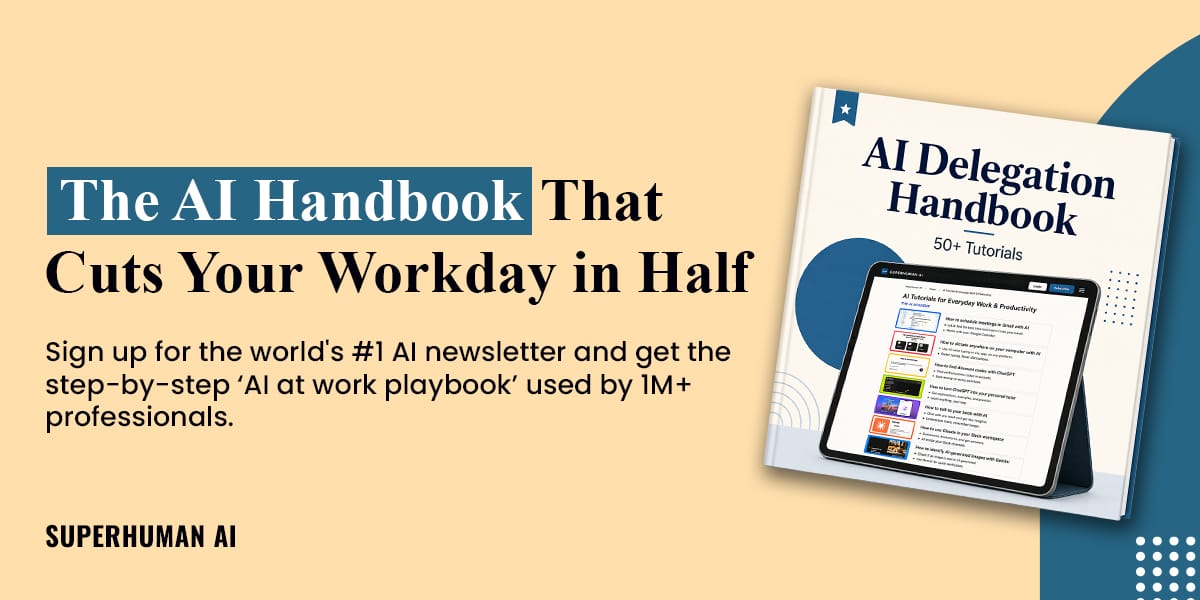
The 8-hour workday is becoming a 4-hour workday for people who know how to use AI.
Everyone else is still catching up.
This AI work playbook shows you exactly how to cut your work hours in half using AI.
Sign up for Superhuman AI and get:
50+ step-by-step AI tutorials to cut your workload in half — covering every part of your workday, from emails to strategy, used by 1M+ professionals at Google, Microsoft, and NASA
Superhuman AI newsletter (4 min daily) so you keep discovering new AI tools and skills to stay ahead in your career — the playbook is just the start
Reading List
Canonical engineers used TLA+ to reproduce and analyze a rare SQLite WAL checkpoint bug that remained undiscovered for 16 years, ultimately validating SQLite’s fix and understanding the exact corruption scenario. They then modeled dqlite’s locking behavior and showed that dqlite is not affected because it prevents concurrent writes and checkpoints.
A practical introduction to PostgreSQL 19 Property Graphs, covering graph modeling, MATCH queries, and how graph traversals map directly to relational joins. The author also discusses limitations such as the lack of variable-length path support and when property graphs are a better fit than a dedicated graph database.
A hands-on build log for a custom RL-powered octocopter designed to survive single and multi-motor failures. The project combines CAD, CNC fabrication, electronics, system identification, MuJoCo simulation, and reinforcement learning for real-world fault-tolerant flight.
Trace one prompt from gateway to scheduler, KV cache, GPU, and network - every component that powers AI inference.
The article explains that AI coding autonomy should be calibrated by task risk, reversibility, and verification, not treated as a status badge or single ladder. It lays out six levels, from simple assistance to managed-by-exception agent orchestration, with the key engineering skill being choosing the right level and evidence for each task.
The article finds that URLs can steer an LLM’s output only when the URL or identifier and its content appeared in training data; otherwise, a bare link is just a string. It also shows that JavaScript-rendered sites may be invisible to training crawlers, so server-rendered content is safer if you want models to learn from a page.
ScyllaDB replaced separate summary and index files with a trie-based SSTable index format to improve cache efficiency, cut disk I/O, and reduce memory overhead. The post details how the new format evolved from ScyllaDB 2025.4 to the default in 2026.2, including tradeoffs and benchmark comparisons against the legacy index format.
How AI could destroy mathematics and barely touch it.
Rhysida derives every per-file AES key from a PRNG seeded with the encryption timestamp. Recover the timestamp and you regenerate every key. A reverse-engineering walkthrough and a minimal decryptor.
Watch, Listen
A keynote conversation between Linux creator Linus Torvalds and open‑source veteran Dirk Hohndel at a Linux Foundation event, covering Linux’s steady release model, dropping legacy hardware support (e.g., 486), and the ongoing C vs. Rust discussion.
Six times in fifteen years, Amazon Web Services went down and took half the internet with it. Airlines, hospitals, banks, smart home devices, Amazon's own delivery trucks. They were all frozen, all tracing back to a single data center in Northern Virginia. This is every major AWS outage, what caused each one, and why the same region keeps failing over and over again.
The episode explains how DBSP makes it possible to incrementally maintain any SQL query by turning data changes into weighted Z-sets and compiling queries into deterministic incremental programs. It covers how Feldera applies the research in a real query engine, why backfills are still hard, and how this differs from traditional materialized views and stream processors like Flink or Kafka Streams.
Interesting Projects, Tools and Libraries
An interactive map of the open-source AI ecosystem that highlights existing projects and exposes missing pieces across data, models, tooling, and infrastructure. Its goal is to guide investment and development toward the highest-impact gaps in public-interest AI.
A curated directory of PostgreSQL extensions and tools. Replace Redis, Elasticsearch, Kafka, and MongoDB with one database you already know.
Never stop coding. Free AI gateway: one endpoint, 231+ providers (50+ free), connect Claude Code, Codex, Cursor, Cline & Copilot to FREE Claude/GPT/Gemini. RTK+Caveman stacked compression saves 15-95% tokens, smart auto-fallback, MCP/A2A, multimodal APIs, Desktop/PWA.
Box3D is a 3D physics engine for games.
Servers and edge devices should have an "outer" graphical shell.
World's First OSS Flink Accelerator built on Apache DataFusion.
Your GitHub stats, turned into a World-Cup-style player card.
Agent multiplexer that lives in your terminal.
Python Weekly - A free weekly newsletter featuring the best hand curated news, articles, tools and libraries, new releases, jobs etc related to Python.
Founder Weekly - A free weekly newsletter for entrepreneurs featuring best curated content, must read articles, how to guides, tips and tricks, resources, events and more.